Practice · 7 November 2026 · 6 minute read
Approaching identified companies: from website visit to conversation
Approaching website visitors in B2B: ranking the signals of an identified company, researching contacts and staying legally clean at first contact.
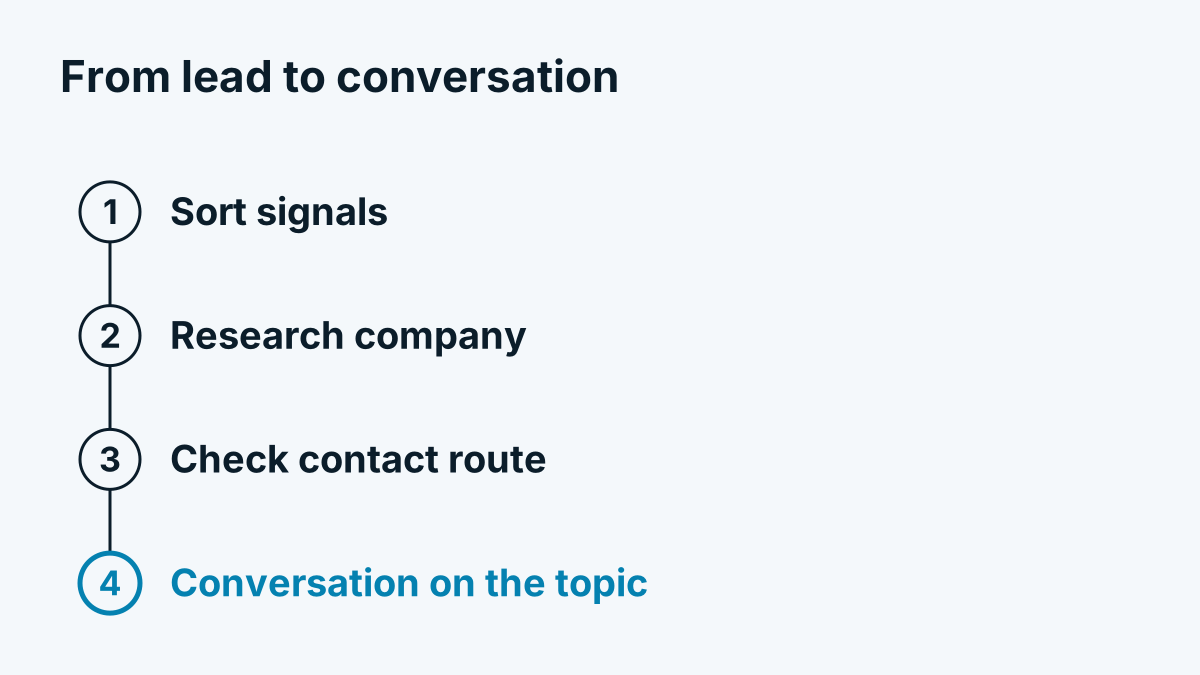
Your report shows a company that was on your website three times yesterday. And now? This is exactly where many sales teams fail. Either nothing happens, because nobody knows what to do. Or too much happens. Then a hint turns into an unwelcome call.
This article describes a process in between. It starts from one principle: an identified company is a hint, not a lead. You know that someone from an organisation was on your site. You do not know who, with what concern, and whether this person has anything to do with purchasing at all.
Rank the signals
Do not start with the company, but with what it did. A visit to the home page says little. A pricing page, a download, a return visit or a click on a phone link say more. Which page views really count is explained in Spotting buying interest: which page views count.
Sort the companies roughly into three piles:
- Fits and shows interest. The company belongs to your target group and has shown several strong signals.
- Fits, but little signal. Watch, do not touch.
- Does not fit. Service providers, competitors, applicants, students. Sort out.
For the first pile, a target group that automatically marks suitable companies for you is worthwhile. What that looks like in a visitor identification tool is described in the help section under Creating target groups.
Research
Before anyone picks up the phone, a quarter of an hour of research per company is worthwhile:
- The company's website. What does it do, how big is it, where is it based? Does it really fit your offer?
- General contact routes. The legal notice and the contact page often give a general address or phone number. These are routes the company has deliberately published.
- Existing relationship. Check in the CRM whether the company already exists there. Perhaps a colleague knows someone there, or there was an offer in the past.
The third point is the most valuable. If you know someone there, most of the risk in this article falls away, because then it is a follow-up within an existing relationship.
Keeping first contact legally clean
This is where it gets serious. So first: this is not legal advice. We classify the basics. For your case, ask a lawyer.
The Act against Unfair Competition names in section 7 paragraph 2 several cases that always count as unreasonable nuisance (version as on gesetze-im-internet.de, retrieved on 06.11.2026):
- Phone: advertising calls to consumers without prior express consent. For other market participants, that is in B2B, at least presumed consent is enough. What counts as presumed is interpreted narrowly. According to the prevailing view, it is not enough that a product would be useful to the business. A visit to your website alone is not proof of it.
- Email, fax and automated calls: advertising without the recipient's prior express consent. This requirement also applies to companies. There is an exception for existing customers in paragraph 3, but only under four conditions, including the reference to the right to object each time the address is used.
Austria and Switzerland
The rules above come from German law. Austria and Switzerland have their own provisions:
- Austria: advertising calls are inadmissible without prior consent under § 174 para. 1 TKG 2021, including towards companies. Presumed consent as in Germany is not enough here. For advertising emails, § 174 paras. 3 and 4 TKG 2021 apply (text in the Federal Legal Information System, retrieved on 06.11.2026).
- Switzerland: Art. 3 para. 1 lit. o UWG regulates mass advertising by email. Lit. u regulates dealing with the star entry in the telephone directory, that is the note that no advertising calls are wanted (text on fedlex.admin.ch, retrieved on 06.11.2026).
It follows for you: an identified company is no reason for an advertising email. We do not recommend cold emails to addresses you found through a visit. This also applies if the address is publicly listed in the legal notice.
What remains is a lot:
- an enquiry to a contact with whom you already have a relationship
- a conversation at a trade fair or in a network
- content that leads to enquiries, which you then answer
- postal mail, and in Germany in B2B also the phone if presumed consent exists. Always with a view to the individual case and the legal position.
For the data processing itself, too, the following applies: whether and how you may use visit data depends on your set-up. More on this in Consent or legitimate interest: how to decide.
Opening a conversation without a feeling of surveillance
Even if you have a legal route, the question of tone remains. The most common mistake: „We saw that you were on our pricing page yesterday.“ That sounds like observation and ends conversations faster than it starts them.
Instead, open with the topic that might concern the company:
- „Many businesses in your industry are asking us about X right now. Is that an issue for you too?“
- „We have published a new analysis on Y. May I send it to you?“ (only if a contact already exists)
The knowledge about the visit stays with you. It helps you choose the right topic, but it does not appear in the first sentence.
A weekly routine
A fixed rhythm beats occasional action. A suggestion:
- Monday, 15 minutes: read the previous week's report. If you receive a weekly report by email, it is the basis. How to set it up is described under Setting up the weekly report and instant email.
- Choose three companies from the first pile. Not ten.
- Use relationships: who on the team knows someone there? Who has spoken with the company before?
- Initiate contact only via existing or permitted routes.
- Note the result: did something come of it or not? This way, after a few weeks you can see whether the signals you look for are worth anything.
The last point is the least conspicuous and the most important. Without a note, after three months you will not know whether the company list has moved your business.
What you should not expect
Visitor identification provides hints about organisations, not about people. It sees only visits from company networks, not from home offices. An identified company may get in touch later or never. Promises about how many conversations result would be unreliable. An honest picture of the possibilities and limits is given in What visitor identification can and cannot do.