Practice · 7 November 2026 · 5 minute read
B2B sales process: where the website supports every stage
The stages of B2B sales from target list to aftercare and what the website can do at each stage. With a table and checking questions.
In B2B sales, hardly anyone buys after the first conversation. Between first contact and signature there are often weeks or months, several participants and many questions. A sales process defines which stages are passed through and who does what at each stage. The website is often forgotten, although it works at every stage, even when nobody is there.
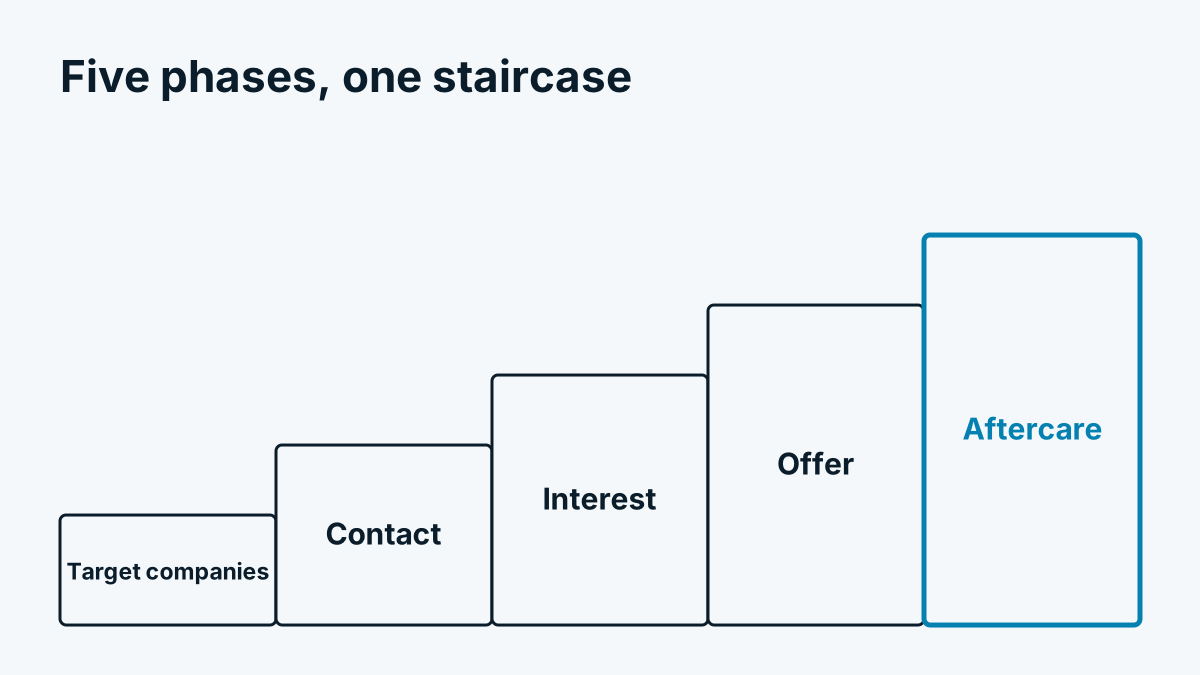
Five stages found in almost every B2B sales process
The names differ from company to company. The order is usually the same:
- Define target companies. Who qualifies as a customer? An ideal customer profile helps with this.
- Win attention. The target companies learn that you exist. They know what for.
- Clarify interest. There is a first conversation or an enquiry. Someone checks whether need, budget and timeframe fit.
- Quote and decision. Several people compare, calculate and coordinate. Who takes part is described in Buying centre in B2B: who takes part in the decision and what they want to know.
- Aftercare and follow-up business. The customer is onboarded, looked after and later receives another offer.
What the website does at each stage
| Stage | Job of the website | How you notice |
|---|---|---|
| Define target companies | Shows which companies already drop by | List of visiting companies, sorted by industry |
| Attention | Answers search queries with specialist articles | Visits via search to guide pages |
| Clarify interest | Makes the next step easy | Enquiries, appointment bookings, downloads |
| Quote and decision | Supplies evidence for those not present | References, pricing page and technical data are read |
| Aftercare | Answers questions without a call | Help pages, guides, fewer follow-up questions |
Stages 1 and 2: finding and being found
Before the first approach, a look at your own visitor list is worthwhile. Which industries and company sizes come on their own? That is often a more honest picture of your target group than the wish list in the sales plan. How such data arises and what it does not show is covered in Which companies visit my website? 3 ways at a glance.
Attention comes from content that answers a specific question from your target group. Nine possible ways are collected in B2B lead generation via your website: 9 ways without purchased addresses.
Stage 3: clarifying interest
This is where it is decided whether a visit becomes a conversation. Three things help:
- A visible next step on every page, not only on the contact page.
- A short form with the details you really need. Every additional mandatory field costs enquiries.
- A clear statement of what happens next. „We will get back to you within two working days“ removes the uncertainty.
The handover from marketing to sales is the most common point of failure. How to regulate it is described in MQL and SQL: handing leads over to sales cleanly.
Stage 4: a decision without you in the room
At this stage your offer is discussed internally, without you. Anyone who joins the circle later looks at your website to form their own picture. If there is no price orientation, reference example or technical description there, the question stays open or is answered to your disadvantage. This applies especially to roles you have never spoken to.
If several people from the same company visit your pricing and reference pages within a short time, that is an indication that comparisons are being made internally. You cannot know for sure. Which signals carry more weight is shown in Recognising buying interest: which page views count.
Stage 5: aftercare relieves sales
After the deal is closed, the website supports onboarding. Guides, help articles and a page with frequently asked questions save follow-up questions. They also show whether a customer suddenly reads the pricing or contract page again. That can point to an upgrade or to an intention to cancel.
The process on one page
Write down one page for your sales team, with these columns: stage, goal of the stage, person responsible, handover criterion, pages of the website that support this stage. Where the last column stays empty, content is missing. Where the person responsible is missing, nothing often happens between two stages.
Frequently asked questions
Do I need a CRM for the sales process? Not necessarily to start with. A table with stage, company, next step and date is enough to practise the discipline. A CRM is worthwhile once several people work on the same case.
What is the difference between a sales process and a customer journey? The sales process describes what your team does. The customer journey describes what the customer experiences. Both run in parallel, more on this in Customer journey in B2B: stages, touchpoints, measurability.
How long may a stage take? That depends on your product. Measure the duration of your own deals over the last twelve months and derive benchmarks from them, instead of adopting figures from other industries.