Basics · 7 November 2026 · 4 minute read
Customer journey in B2B: stages, touchpoints, measurability
The B2B customer journey in five stages: touchpoints per stage, what can be measured on your website and what you will never see.
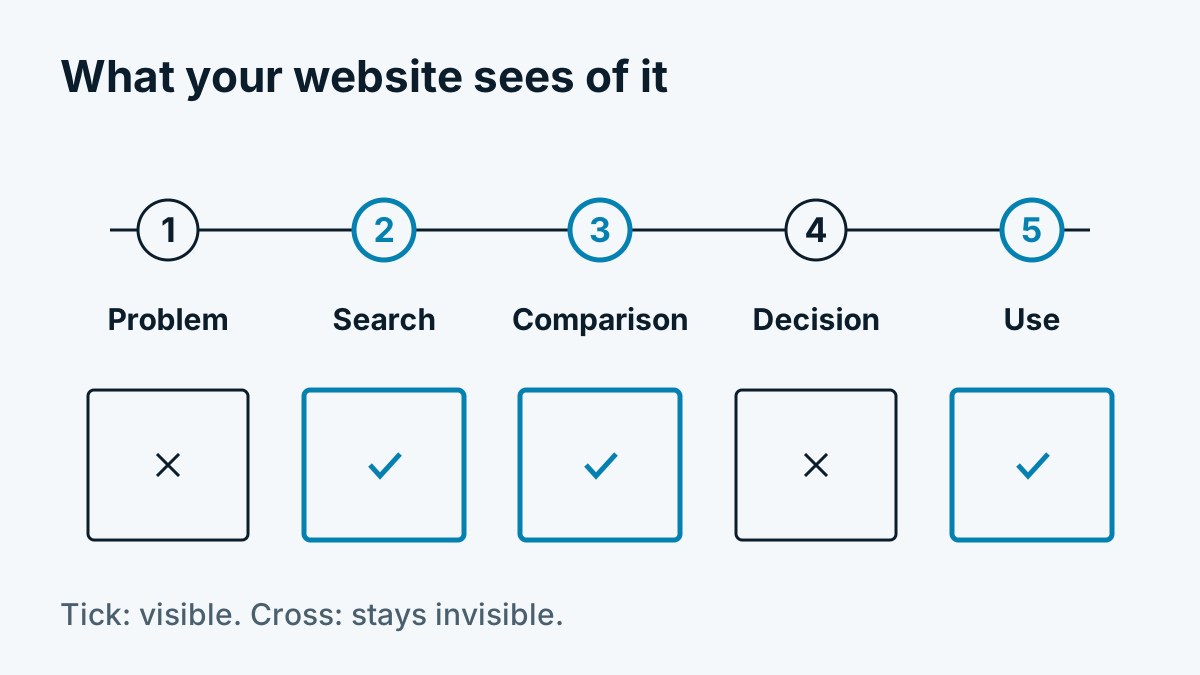
The customer journey describes a customer's path from the first inkling of a problem to the decision and beyond. In B2B this path is longer and less clear than in an online shop. Several people decide. A large part of the research takes place where you cannot watch. Anyone who maps the journey quickly notices how little of it shows up in their own figures.
The five stages
The scheme is a working model, not a law of nature. A journey never runs as straight as it looks on paper. But it helps to find gaps.
| Stage | What the customer does | Typical touchpoints |
|---|---|---|
| Recognising the problem | Notices that something no longer works | Conversation in the team, trade media, trade fair, search engine |
| Searching for solutions | Looks up terms and approaches | Guide articles, videos, colleagues, industry associations |
| Comparing providers | Puts together a shortlist | Websites, review portals, recommendations, pricing pages |
| Deciding | Requests quotes, coordinates internally | Conversation with sales, quote, references |
| Using and staying | Introduces, uses, renews or cancels | Onboarding, help pages, customer care |
Who takes part in the decision at these stages is covered in Buying centre in B2B: who takes part in the decision and what they want to know. How sales fits in is described in B2B sales process: where the website supports every stage.
What you can measure on your website
Everything that happens on your own website can be recorded, provided the visitor has consented and your settings allow it:
- Where a visit comes from (search, link, direct entry).
- Which pages were read and in which order.
- Which actions took place: download, form, appointment booking.
- Whether someone comes back, if they can be recognised.
- Which company is behind it, if it uses its own network and company identification is running. What that means and what it does not is explained in What visitor identification can do and what it cannot.
From this information a piece of the journey emerges, namely the piece on your domain.
What you do not see
The most important point first: a lot is missing. This includes:
- Conversations between colleagues. The recommendation that triggered the visit appears nowhere.
- Research on other sites, in forums, groups and review portals.
- Device changes. The visit on a phone in the morning and the visit at the workstation at noon are two different people in your figures.
- Home working and mobile internet. Anyone who comes via a home network, VPN or mobile network cannot be assigned to a company, see Home office, VPN and mobile networks: who you cannot see.
- Visitors without prior consent. They are missing from the statistics.
It follows that the measured journey is a skewed sample. It shows what became visible on your site. It does not show the whole path.
How to proceed in practice
- Retrace the journey of your last five new customers. Ask them in conversation: how did you find us? What did you look at beforehand? Who took part in the decision?
- Enter the answers in the table. Where do several customers say the same thing? Those are your most important touchpoints.
- Ask in the enquiry form. An optional free-text field „How did you hear about us?“ often delivers more than any analysis of the source.
- Decide what you want to measure. One figure per stage: visits to guide pages, visits to pricing and reference pages, enquiries, deals closed.
- Check quarterly whether journey and figures still fit together.
Typical mistakes
- The journey is a funnel. In B2B, prospects jump back, skip stages or reappear after months.
- Counting only clicks. A comparison in the decision stage often happens in a document that circulates internally and is never opened on your website.
- One journey for everyone. A company with ten employees buys differently from a corporation. Draw two simple journeys rather than one diluted one.
- Measured values as proof. A single visit does not show buying interest. How to weight signals is shown in Recognising buying interest: which page views count.
Frequently asked questions
Do I need marketing software for this? No. Interviews with customers and a table are enough to start. Software only helps once the questions are clear.
How many touchpoints does a B2B journey have? That cannot be said in general. It depends on product, price and risk. Only your own deals are meaningful, not averages from other industries.
Can I follow a company across the whole journey? Only where it identifies itself, for example through a form, or where its network address can be assigned to it. Gapless tracking is neither possible nor necessary.