Practice · 7 November 2026 · 4 minute read
Creating an ideal customer profile: a guide with template
Derive an ideal customer profile (ICP) from your best existing customers: six steps, how it differs from a persona, and a template as a table.
An ideal customer profile, ICP for short, describes the kind of company for which your offer is the best fit. Not the company you would like to have, but the one where selling, onboarding and working together actually go well. With an ICP, sales and marketing know where to spend their time. For everyone else, they can politely say no.
ICP and persona: two different things
The two terms are often confused.
| Ideal customer profile | Persona | |
|---|---|---|
| Describes | a company | a person in that company |
| Attributes | industry, size, region, technology, trigger | role, goals, worries, sources of information |
| Answers | Whom do we address? | How do we address them? |
| Used for | selecting target companies, lead scoring | content, tone of voice, channel |
The ICP comes first, then the people within it. How these people work together in a purchase is described in Buying centre in B2B: who takes part in the decision and what they want to know.
Six steps to an ICP
- List your customers. All customers of the past two to three years in a table, one row per company.
- Mark the best ones. Criteria: revenue, length of the relationship, low support effort, referrals, quick close. Take about a fifth of the list, but at least five companies.
- Collect attributes. For each marked company: industry, number of employees, region, legal form, technology in use, who decided, what the trigger was.
- Look for patterns. Which attributes do at least half of the best customers share? These are candidates for the profile.
- Cross-check with the worst customers. Which attributes do the companies have that caused trouble or cancelled? These become exclusion criteria.
- Write it down on one page and discuss it with sales. Their instinct for outliers is valuable.
Template as a table
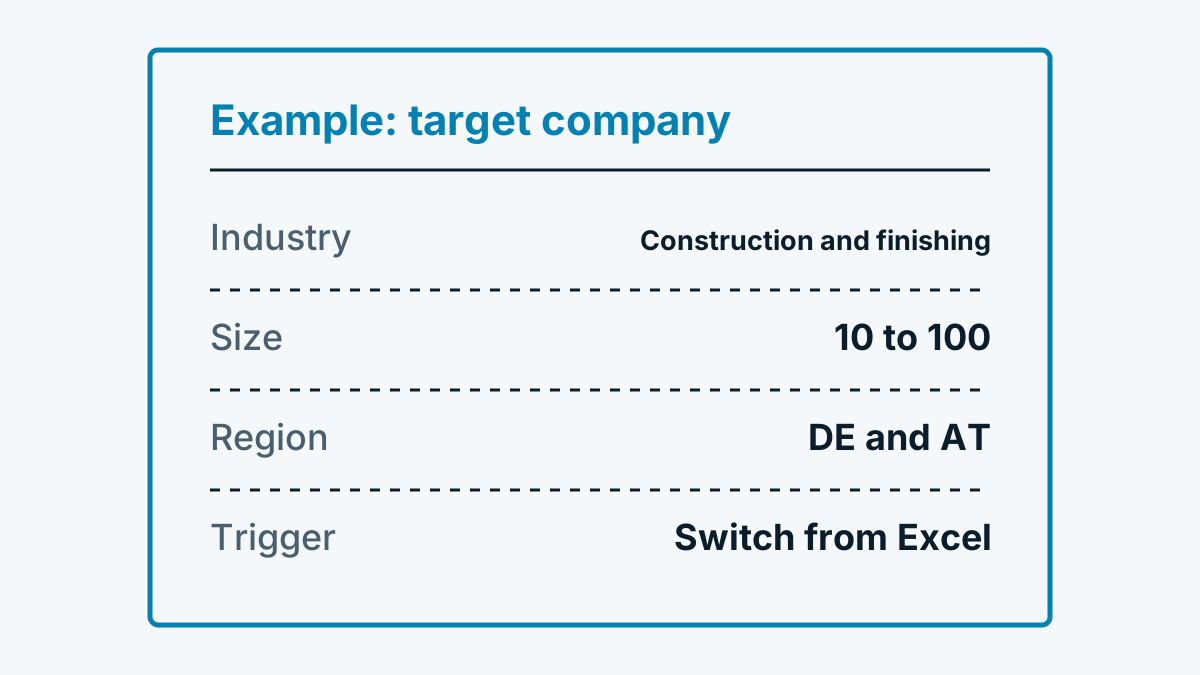
Copy these rows into your document and fill them in. The example belongs to a fictitious company that sells time-tracking software for trade businesses.
| Attribute | Must | Should | Exclusion |
|---|---|---|---|
| Industry | construction and finishing trades | electrical, plumbing | retail |
| Size | 10 to 100 employees | under 5 employees | |
| Region | DE, AT | CH | outside DACH |
| Trigger | switching from paper or Excel | new location | industry-specific solution already in use |
| Decision-maker | management or office manager | group purchasing only | |
| Technology | mobile phone for staff on site | no internet on building sites | |
| Benefit for us | a standard case, hardly any customisation | special requests beyond the standard |
The columns have a purpose: „Must“ is the minimum, „Should“ adds points in scoring, „Exclusion“ is a no, however great the interest. The values in the example are entirely invented and only show the form.
Where to find the attributes
- From your own CRM: industry, size, time to close, support effort.
- From conversations with sales: who decided what, which trigger set things off?
- From customer surveys: two questions are enough, namely „Why did you get in touch with us back then?“ and „What tipped the balance?“
- From your own website: which companies come repeatedly and read pricing and reference pages? What sets them apart can be seen in a visitor list, see Which companies visit my website? Three ways at a glance.
What you do with the ICP
- Target list for account-based marketing: Account-based marketing: turning your website into a measuring point.
- Fit axis in lead scoring: Lead scoring in B2B: a simple model based on website signals.
- Criterion for an MQL: MQL and SQL: handing leads over to sales cleanly.
- Filter for visitor lists: a recognised company outside the profile does not get a call.
Typical mistakes
- Wish customers instead of existing customers. An ICP made up only of hope delivers leads that never close.
- Too many attributes. Five to eight are enough. Anyone who sets twenty conditions finds no company.
- Written down once, never checked. Check the profile against your new customers once a year.
- Too narrow a view. Even a very small customer base can yield a profile, but with five customers it is more of a hypothesis than a finding.
Frequently asked questions
What if I have no customers yet? Then start with a hypothesis drawn from conversations with potential customers and replace it as soon as the first deals are closed. Until then, clearly label it as an assumption.
May I have several ICPs? Yes, if you serve different products or markets. Start with one. Two profiles in a company with two employees usually mean that neither is put into practice.
How precise does the size have to be? A range is enough. Number of employees and revenue are approximations. More important is whether the company has the problems you solve.