Practice · 7 November 2026 · 4 minute read
Lead scoring in B2B: a simple model based on website signals
Lead scoring without expensive software: a points model of fit and behaviour, with an example table, thresholds and a monthly check.
Lead scoring answers a simple question: whom does sales call first? Instead of deciding by gut feeling, every company or contact receives a points value. Anyone above a threshold is followed up. That sounds like big marketing software, but it works with just a table and a few clear rules.
Two questions, two axes
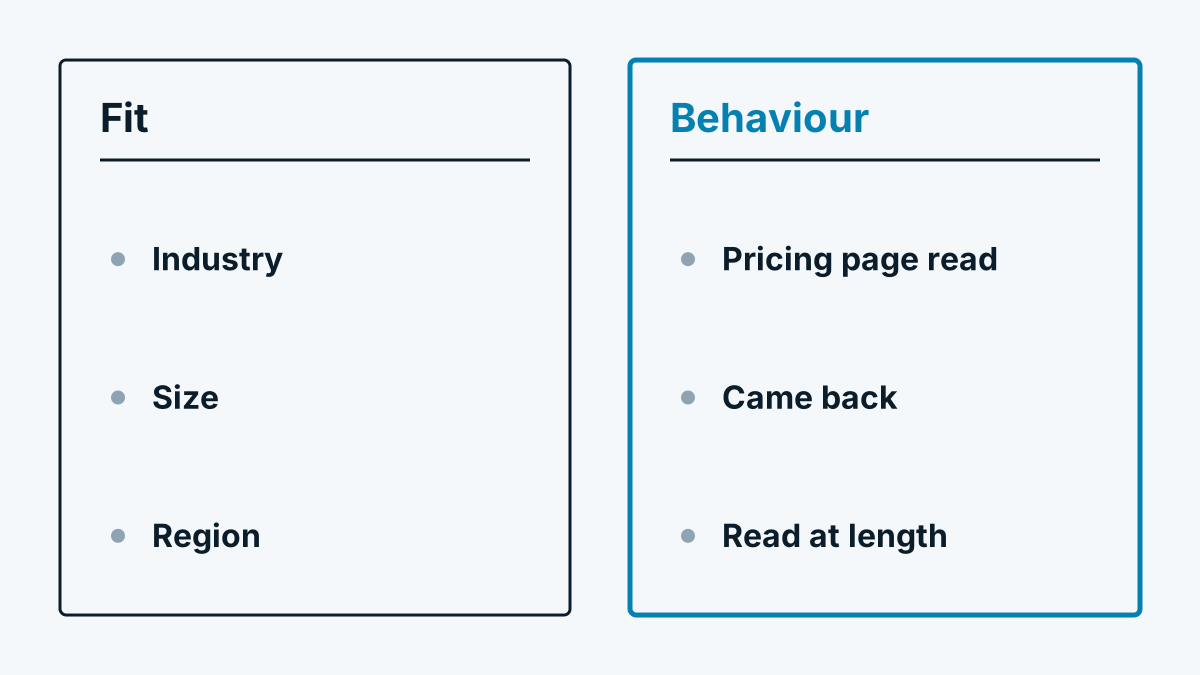
A good model separates two things that are often mixed up:
- Fit: does the company match what you sell? Industry, size, region, technology in use.
- Behaviour: is the company showing interest right now? Visits to the website, downloads, sign-ups, replies to emails.
A company with a perfect fit that never comes to your website is a target for marketing, not for a call. A company that reads every day but would never buy only costs time. The interesting part is the intersection.
An example model
The points are a suggestion. Adapt them to your business.
| Attribute | Points |
|---|---|
| Fit | |
| Industry from your core target group | 20 |
| Size in the target range (for example 50 to 500 employees) | 15 |
| Headquarters in your delivery area | 10 |
| Behaviour in the last 30 days | |
| Pricing page read | 25 |
| Case study or reference read | 15 |
| Came back on at least two days | 15 |
| Actively read for more than three minutes | 10 |
| Visited only the careers page | minus 30 |
| Existing customer | treat separately |
The deductions are just as important as the points. Someone who only reads job ads is very probably an applicant and not a buyer. Which page views are especially telling is covered in Spotting buying interest: which page views count.
Setting thresholds
Divide the values into three ranges:
- From 70 points: sales gets in touch within two working days, referring to the topic the company has read.
- 40 to 69 points: marketing takes care of it, for example with suitable content, invitations or ads.
- Under 40 points: watch, do nothing.
It is important that both teams set the thresholds together. Otherwise sales complains about bad leads and marketing about leads left lying.
Letting points expire
Interest is limited in time. Someone who read the pricing page three months ago may have decided long since. So count behaviour points only for the last 30 days, or deduct a portion every month. Fit points remain as long as nothing changes about the company.
Check every month
A model is an assumption. Check it once a month with three questions:
- How many companies above the threshold turned into a conversation? If there are almost none, the threshold is too low or the points are wrongly distributed.
- Where did the deals of the last months come from? Did these companies have high scores beforehand? If not, an attribute is missing from the model.
- Which attributes keep appearing with good leads? These get more weight.
Where the data comes from
- Fit: from your CRM, from public company data or from the company's website.
- Behaviour on your website: at company level from a visitor identification tool; at the level of individual contacts only if someone has signed up or filled in a form.
- Behaviour in emails: from your newsletter tool, provided recipients have consented.
For values at the level of individual people, the GDPR applies. Scoring that decides automatically about people is more sensitive than scoring that sorts companies. In B2B, stay at company level where possible. The basics are in Visitor identification and GDPR: a sober assessment.
Frequently asked questions
Do I need a marketing automation tool for this? Not to begin with. A table with formulas and a weekly export are enough to test the model. A tool is worthwhile once the rules are settled and volumes grow.
How many attributes make sense? Five to ten. More makes the model hard to understand. Nobody trusts a value they cannot explain.
What is the difference from intent data? Lead scoring is the model. Intent data is one possible ingredient, see Intent data in B2B: what buying signals really show.