Comparison · 7 November 2026 · 5 minute read
B2B lead generation: choosing an agency, spotting warning signs
How to recognise a reputable B2B lead generation agency: contract models compared, warning signs and twelve questions for the first meeting.
A lead generation agency promises appointments, enquiries or contacts. For small and mid-sized B2B companies this can make sense if time or experience is lacking in-house. But there are also providers whose methods damage your brand or get you into legal trouble. A few questions up front separate the two groups quite reliably.
What agencies mean by lead generation
The term covers very different things:
- Content and search engines: specialist articles, guides, landing pages. Works slowly but lastingly.
- Paid ads: Google Ads, LinkedIn. Works quickly, ends with the budget.
- Events: webinars, trade fairs, roundtables.
- Outreach: phone, email, letter, messages in networks. Legally the most delicate part.
- Data: buying addresses, enriching your own records.
Ask every agency in which of these fields it actually works. Anyone who offers everything is rarely good at all of it.
Contract models compared
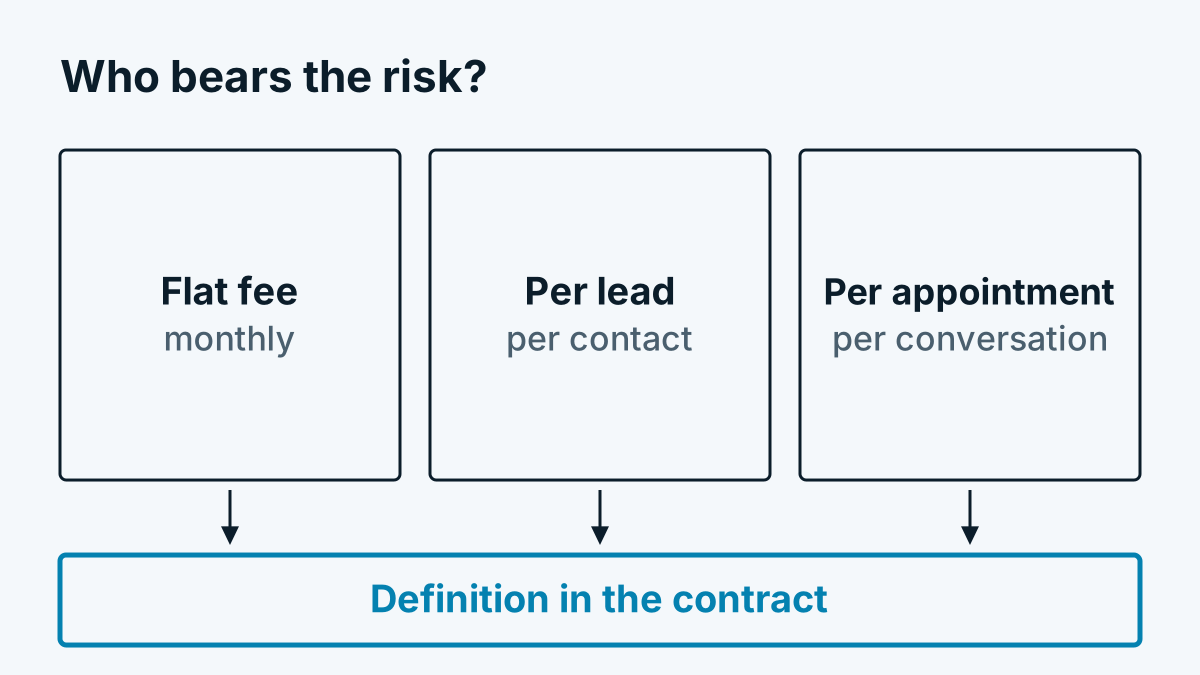
| Model | Advantage | Risk | Suits |
|---|---|---|---|
| Flat fee (monthly charge) | Predictable, the agency can work for the long term | Payment regardless of the result | Content, search engine, ad management |
| Per lead | Payment only on results | The term „lead“ is interpreted loosely, quantity beats quality | Clearly defined forms with checking criteria |
| Per appointment | Closer to sales | Appointments are „bought“, participants are poorly prepared | When appointments are defined in writing |
| Hybrid (base plus success share) | Both bear risk | Check whether the success share is an incentive at all | Most cases |
With „per lead“ and „per appointment“ the definition decides. Write it into the contract, with the same criteria as in MQL and SQL: handing leads over to sales cleanly: fit with the ideal customer profile, responsibility, need. Without a definition you pay for contacts, not for opportunities.
Warning signs
- Purchased address lists. „We have 200,000 decision-makers in the database“ sounds like reach. Anyone who contacts such addresses needs a legal basis for it. For email in B2B in Germany and Austria that is prior consent, see Cold outreach in B2B: what is allowed in Germany, Austria and Switzerland. A purchased list does not replace it.
- Cold emails without prior consent. Even if the agency says this is „standard in the industry“. The responsibility lies with you as the sender, not only with the agency.
- Fixed promises about volume and timing. Nobody can guarantee 20 appointments a month without knowing your product and your market precisely.
- Vague method. Answers such as „our proprietary process“ to the question of how the leads are generated.
- Access only to the agency's reports. You should have access to your ad account, your analytics and your data.
- Long commitment with no exit. Twelve months' term without an interim target is a risk if you do not yet know the agency.
- References without names. Reputable agencies name at least one client you may call.
- Promises with figures but no source. „Up to 400 percent more leads“ without a measuring method and time frame is advertising, not evidence.
Good signs
- The agency first describes your offer and your target group, not its own services.
- It proposes routes where prospects get in touch themselves: content, ads, events. Nine such routes are listed in B2B lead generation via the website: 9 ways without purchased addresses.
- It explains how consents are obtained and documented.
- It names risks and limits openly and admits what it cannot do.
- The contract contains targets you can check. After a trial phase there is an option to exit.
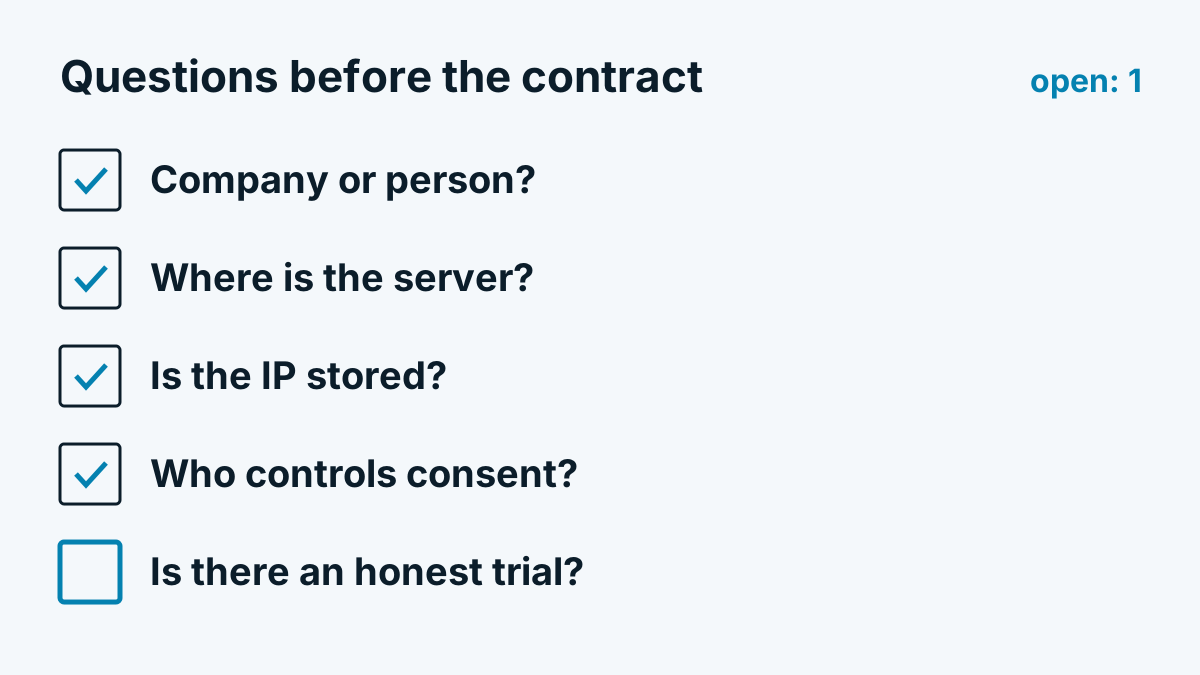
Twelve questions for the first meeting
- Which channels do you use for clients like us, and why?
- Where do the contacts you approach come from?
- On what legal basis does the outreach take place per channel and country?
- How is consent obtained, stored and demonstrated?
- How do you define a lead or an appointment? Who decides in a dispute?
- How do you handle objections and suppression lists?
- Who on your team actually works on our account?
- Which figures do you report? Do we get access to the raw data?
- Who owns accounts, texts, lists and analyses after the contract ends?
- Which client may we call as a reference?
- What happens if the agreed targets are not met after three months?
- Which tasks stay with us, and how much time do you need from us for them?
Write the answers down. Anyone who dodges question 2 or 4 has probably not answered them well.
Before the agency: check your own house
An agency brings enquiries, but it does not replace a website that builds trust. Nor does it replace a sales team that calls back promptly. Check beforehand whether you know which companies are already coming and what they read. With a visitor list and a simple scoring model you often see that the existing visits offer more than has been used so far. That saves budget for the agency, which can then use it in a more targeted way.
Frequently asked questions
What does an agency cost? Prices vary greatly by scope and provider. State your budget up front and have them show you what is feasible for it, instead of adopting flat figures from the web.
Is buying address lists prohibited? The purchase itself not necessarily, but using them for advertising often is. For email you generally need prior consent from the recipients, which you must be able to demonstrate to the supervisory authority. If in doubt, ask a lawyer.
Is „per appointment“ enough as a model to keep the risk small? It lowers the risk on the fee, not on quality. Specify who must attend the appointment and what preparation you expect, otherwise you pay for conversations that lead nowhere.