Practice · 7 November 2026 · 5 minute read
Competitors on your website: spotting and assessing them
Competitors read your website too. How to spot them in company visits, what you show publicly and how to observe competitors properly yourself.
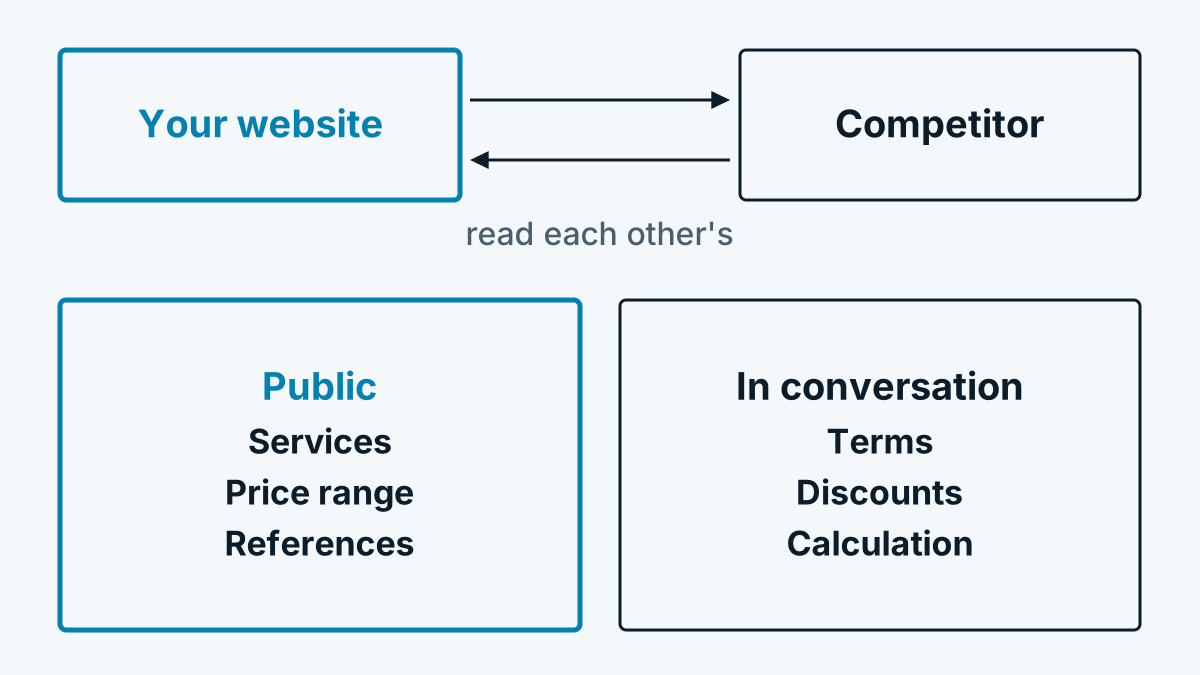
Anyone looking at a list of the companies that have visited their own website sometimes finds names there that will not become customers: competitors. This surprises many, but it is normal. Anyone who reads your pricing page and looks at your references is doing what you do to them. This article explains how to recognise such visits, what follows from them and how to observe the market properly yourself.
Why competitors read along
Every public page is there for everyone. Competitors look for good reasons:
- They check your prices and packages to place their own offer.
- They read references and industries to see where you are strong.
- They watch new services and job ads to notice developments early.
- Sometimes they are service providers or consultants researching for a third party.
This is not objectionable. Competition law does not prohibit observing public offers. The German Trade Secrets Act expressly makes clear that a product made publicly available may be observed, studied and tested (§ 3 GeschGehG). What you publish is not secret.
How to recognise competitors in company visits
Visitor identification shows the company behind the network, not the person. How this works and where the limits lie is covered in Which companies visit my website? Three ways at a glance. Competitors stand out in the list through typical patterns:
| Pattern | What it suggests |
|---|---|
| Company from your industry that you know | Market observation |
| Targeted route: pricing, references, services, no contact | Comparison rather than buying interest |
| Regular visits at intervals of weeks | Routine observation |
| Visit shortly after a price change or press release | Reaction to news |
These are hints, not proof. A visit from a company network does not say who exactly sat at the computer. Suppliers, applicants or prospects with a similar line of business also appear this way. And identification is not complete, as Identification rate: why the figures vary so much shows.
How to deal with it
Classify such visits in the evaluation instead of counting them as prospects:
- Mark known competitors in your list so that they do not end up in the sales list.
- Take them out of the scoring. Someone who reads your pricing page without being able to become a customer should receive no points for buying interest. How scores are built is covered in Lead scoring in B2B: a simple model based on website signals.
- Do not call. A competitor reading your site is no reason for sales to start a conversation.
- Read the visits as a signal. Frequent visits to a single page show that it is being noticed in the market.
What you show publicly and what you do not
A simple rule: show what prospects need for the decision. Hold back what only makes sense in conversation.
| Good public | Better in conversation |
|---|---|
| Services, process, target groups | Individual terms and discounts |
| Price range or „from“ prices | Calculation, margins |
| References with the customer's consent | Customer lists without approval, contract content |
| Methods at overview level | Internal processes, tools in detail |
Name references only with the customer's permission. Hiding prices entirely is no protection, because competitors learn them by other routes too. It also costs enquiries from prospects who want to see prices in advance. What is worthwhile for your website is also shown by the B2B website check with 15 points.
Your own competitor monitoring: clean and public
What competitors do to you, you may do to them. Good sources are:
- Websites and price lists of competitors, viewed regularly and recorded with a date (for example as a screenshot).
- Job ads, which show where a company is growing.
- Press releases, specialist articles, talks and trade fair appearances.
- Review portals and references on the competitor's site.
- Commercial and company registers for legal form, registered office, publications. In Germany the Unternehmensregister holds annual accounts and other mandatory publications.
- Alerts for search terms and names.
- Conversations with customers who also know competitors' offers, as far as they tell you voluntarily.
Where the limits lie
The Act against Unfair Competition protects competitors against targeted obstruction and other unfair acts (§ 4 UWG). Simple limits therefore apply to observing:
- No false identity. No sham enquiries under a false name in order to get offers.
- No protected areas. Customer portals, drafts and internal directories remain off limits, even if they appear unprotected.
- No poaching of knowledge. Do not ask new employees for insider information from their former company. The Trade Secrets Act prohibits obtaining secrets through unauthorised access or otherwise dishonest conduct (§ 4 GeschGehG).
- No disruption. Automated requests in large numbers that burden the competitor's site are no longer market observation.
Anyone who sticks to public sources is usually on the safe side. In cases of doubt, ask your legal adviser. In Austria and Switzerland comparable competition rules apply, but the laws are different.
Frequently asked questions
May I lock competitors out of my website? Technically that is possible, for example through IP blocks, but it is laborious and often hits bystanders, because company networks share addresses. For prices and references that you show publicly anyway, it achieves little. Block only if a competitor disrupts your site with mass requests.
Should I write to a competitor who has read my pricing page several times? No. The visits are not buying interest. Approaching them brings no benefit, but trouble.
How reliable is the assignment to a competitor? Not reliable. You only see which company the network belongs to. Who read there remains open. Even an agency in the same building can visit your site.