Law · 7 November 2026 · 5 minute read
B2B newsletter: consent, double opt-in, unsubscribing
B2B newsletters under GDPR and UWG: consent, double opt-in, proof, existing customers, unsubscribing and labelling in DE, AT and CH, with sources.
For many B2B companies a newsletter is the quietest way to stay in touch. Legally, however, it is not a given. In Germany and Austria, business customers too may receive advertising emails only with prior consent. This article summarises what applies to sign-up, proof, unsubscribing and labelling. For cold outreach in general, read Cold outreach in B2B: what is allowed in Germany, Austria and Switzerland. This text is guidance and not legal advice.
Basic rule: consent first, then advertising
| Country | Rule | Source |
|---|---|---|
| Germany | Advertising by email without prior express consent is always an unreasonable nuisance | § 7 Abs. 2 Nr. 2 UWG |
| Austria | Electronic mail for direct marketing purposes requires prior consent | § 174 Abs. 3 TKG 2021 |
| Switzerland | Mass advertising without prior consent is unfair | Art. 3 Abs. 1 lit. o UWG |
The rules apply in B2B just as they do towards consumers. A company address such as info@ is not consent to advertising. An entry in the legal notice is not either.
What makes consent valid
For processing the address under the GDPR, consent must be freely given, specific, informed and unambiguous (Art. 4(11) and Art. 7 GDPR, text on EUR-Lex). In everyday terms this means:
- A separate tick box for the newsletter, not pre-ticked and not tied to the completion of an enquiry.
- Clear wording: what do people receive, how often, from whom? „Newsletter with specialist articles, about once a month“ is better than „info“.
- A note on withdrawal and a link to the privacy policy.
A contact enquiry does not replace consent. Anyone who requests a quote may receive a reply to it, but not a monthly series of advertising.
Double opt-in and proof
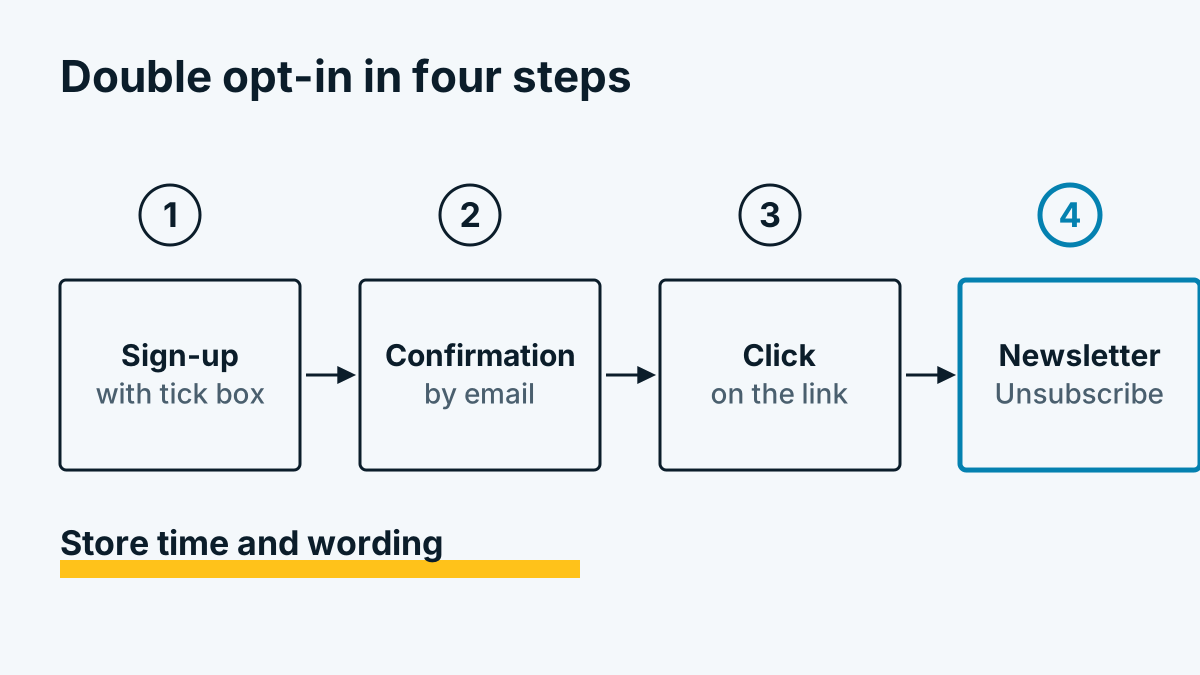
With double opt-in, the address given receives an email with a confirmation link after sign-up. Only after the click does sending begin. This ensures that the address belongs to the person signing up.
In 2011 the German Federal Court of Justice (BGH) regarded the procedure as a suitable way of documenting consent. It is not, however, sufficient as complete proof. If the recipient disputes that the confirmation came from them, what matters is whether the address can actually be attributed to them (BGH, judgment of 10.02.2011, I ZR 164/09, full text). Under Art. 7(1) GDPR you must be able to demonstrate consent. Therefore store:
- time and wording of the sign-up (version of the form text),
- time of the confirmation,
- the address and the route of the sign-up.
Keep the confirmation email simple: link, one sentence, no advertising.
Existing customers: the exception is narrow
All three countries have an exception for existing customers. The conditions are similar:
| Condition | DE § 7 Abs. 3 UWG | AT § 174 Abs. 4 TKG 2021 | CH Art. 3 Abs. 1 lit. o UWG |
|---|---|---|---|
| Address obtained in connection with a sale | Yes | Yes | Yes |
| Advertising only for own similar products | Yes | Yes | Yes |
| Notice of the right to refuse when collecting | Yes, also with every use | Yes, also with every transmission | Yes |
| No objection | Yes | Yes, nor an entry in the list under § 7 Abs. 2 ECG | Yes |
This does not cover prospects, trade fair contacts without a purchase or buyers of entirely different products. The exception applies to email addresses, not to other channels.
Unsubscribing
- A link in every email that unsubscribes with one click, without logging in and without giving a reason.
- No costs beyond the normal transmission costs, plus a valid address for the request to stop sending. In Germany this is required by § 7 Abs. 2 Nr. 3 lit. c UWG, in Austria by § 174 Abs. 5 Nr. 4 TKG 2021.
- Keep a suppression list. So that an unsubscribed address does not accidentally reappear through an import, keep a suppression list with the flag „do not contact“.
- Objection to direct marketing. Under Art. 21(2) and (3) GDPR it is possible at any time. After that, the data may no longer be processed for this purpose.
Labelling and sender
Commercial communication must be recognisable as such. The party on whose behalf it is sent must be named. In Germany this used to be in § 6 TMG and has been in § 6 DDG since May 2024. For email, the sender and the commercial nature must not be disguised in the header and subject line (§ 6 Abs. 2 DDG). In Austria this is regulated by § 6 ECG, and unsolicited messages are dealt with in § 7 ECG.
In practice: a sender name with the company, an honest subject line, legal notice details in the footer of the email and a valid reply address.
Frequently asked questions
Do I really need double opt-in for a B2B newsletter? The law does not prescribe the procedure. But you must be able to demonstrate consent. Double opt-in is the usual way to do that. It also protects against third parties entering other people's addresses.
May I add contacts from a trade fair to the newsletter? Only if the person has agreed to it. A business card handed over can be enough for a reply to an enquiry, but as a rule not for a regular newsletter.
How long does consent last? The law does not state a fixed period. But anyone who has sent nothing for a long time should check before restarting whether the consent still holds. Take advice from your data protection adviser on this. Sign-up often goes through a form, more on this in Contact form in B2B: fields, data protection, spam.